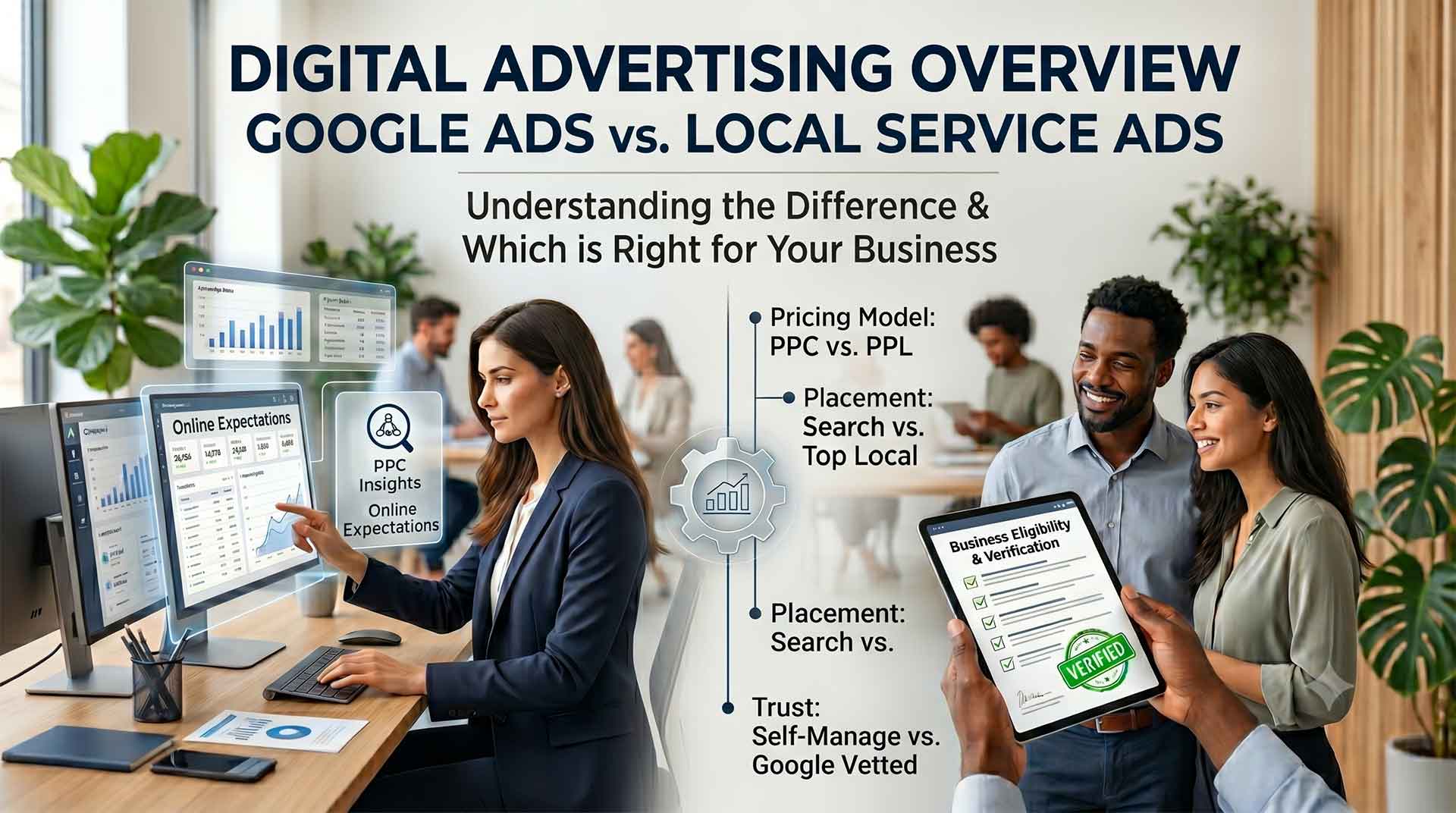
Imagine walking down a busy main street where every storefront is competing for a customer's attention. Online, that main street is the first page of a Google search. When a homeowner searches for an emergency plumber or a local professional, the top of the search page can look crowded. You will see different types of boxes, checkmarks, text, and phone numbers.
Most of these top spots are paid placements, but they do not work the same way. They are split into two completely separate advertising platforms: Google Ads and Google Local Service Ads (LSAs).
For a small or medium business owner, choosing the wrong platform can cause your budget to disappear quickly with little to show for it. This guide breaks down both options in plain English, explaining exactly how they work, who they serve, and how to use them to grow your business.
1. Defining the Platforms in Plain English
To understand which tool is right for your goals, you must first understand how each platform operates. Let us define the key terms and mechanisms using simple, real-world analogies.
What is Google Ads? (The Fishing Rod)
Google Ads is the older, broader advertising system. It operates primarily on a Pay-Per-Click (PPC) model. Think of this like a fishing rod that you have to cast and reel in yourself.
-
How it works: You pick specific words or phrases—called keywords—that you think your customers are typing into Google (for example, "best family shoes" or "local accounting help"). You write a short text message, and when someone searches for those keywords, your ad can appear.
-
The Payment Model: You only pay when someone actually clicks on your ad. Google does not care if that person stays on your website for two hours or leaves after two seconds. A click costs you money regardless of the outcome.
What is Google Local Service Ads? (The Certified Fishing Net)
Google Local Service Ads (LSAs) are a newer, simpler product designed strictly for local, service-based businesses. Think of LSAs like a net that Google drops into the water for you, but only if you are certified to fish in that exact spot.
-
How it works: These ads appear at the absolute top of the search results page, even above regular Google Ads. They feature your business name, star rating, phone number, and a green checkmark indicating you are Google Guaranteed or Google Screened. You do not pick keywords or write ad copy. Instead, Google automatically builds your ad using the details from your business profile.
-
The Payment Model: LSAs operate on a Pay-Per-Lead model. A lead is a real potential customer who reaches out to your business directly through the ad, either by calling your phone or sending a message. You do not pay for casual browsers who click around; you only pay when the phone rings or an inquiry arrives.
2. Core Differences: Control vs. Trust
The choice between these two platforms usually comes down to a balance between creative control and instant customer trust.
Feature / Factor |
Google Ads |
Google Local Service Ads (LSAs) |
Pricing Model |
Pay-Per-Click (PPC): You pay for every click on your link. |
Pay-Per-Lead: You pay only for direct phone calls or messages. |
Ad Placement |
Top and bottom of search pages, YouTube, and partner websites. |
The absolute top of Google Search results. |
Setup Complexity |
High. Requires keyword research, ad writing, and landing pages. |
Low. Requires business verification and profile setup. |
Control Over Message |
Full control. You write the headlines and choose where links go. |
Limited. Google generates the ad based on your business category. |
Trust Signals |
None automatically provided by the ad unit. |
Includes the Google Guaranteed or Google Screened badge. |
Targeting Basis |
Specific keywords, demographics, and user behavior. |
Geographic location and broad service categories. |
3. Who Qualifies for Local Service Ads?
While almost any legal business can use traditional Google Ads, LSAs are highly restricted. To use LSAs, your business must operate within an approved industry and pass a strict background check. This screening includes verifying your state licenses, checking your business insurance, and conducting background checks on company owners or employees.
Google's LSA program currently covers over 70 business types, organized into five primary categories:
-
Home Services: Plumbers, HVAC (heating and cooling) technicians, electricians, roofers, carpenters, landscapers, house cleaners, and pest control specialists.
-
Professional & Business Services: Tax preparers, financial planners, and specific legal practices (such as family law, bankruptcy law, criminal defense, and estate planning).
-
Health & Wellness: Dental practices, physical therapists, and mental health professionals.
-
Personal Care, Education & Pets: Tutors, photographers, event planners, dog walkers, pet groomers, and veterinary clinics.
-
Automotive Services: Auto repair shops, car detailing providers, and towing companies.
If your business does not fall into one of these specific service industries, traditional Google Ads is your primary path forward on the search engine.
4. Industry Deep-Dives: Pain Points, Steps, and Real Examples
Every industry interacts with its customers differently. Let us look at how six major business sectors can use these platforms, exploring their specific needs, actionable steps, and the pros and cons of implementation.
Sector 1: Retail
Retail businesses rely heavily on visual appeal, seasonal trends, and clear product information.
-
Needs & Pain Points: High competition from major online platforms, changing inventory, and thin profit margins.
-
Actionable Implementation Step: Set up a free Google Merchant Center account to link your store inventory directly to Google. Focus your budget on Shopping Ads (a feature within Google Ads) that display images, prices, and availability of your products directly on the search page.
-
Pros & Cons: Regular Google Ads allow you to capture customers who are looking for specific brands or seasonal sales. However, you face the risk of paying for clicks from window-shoppers who have no real intention of buying. LSAs are not available for standard retail.
-
Specific Example: A local boutique shoe store can run a Google Ads campaign targeting the phrase "running shoes near me." The ad can display an extension showing the store's physical address, hours of operation, and a map icon to drive foot traffic.
Sector 2: Restaurants
Restaurants need to capture immediate local hunger and promote group events or dining experiences.
-
Needs & Pain Points: Low customer loyalty, heavy reliance on weekend traffic, and the need to turn casual searchers into immediate diners.
-
Actionable Implementation Step: Run localized Google Ads targeting high-intent phrases during late morning and late afternoon hours. Use ad extensions that allow users to view your menu or click directly to make a reservation.
-
Pros & Cons: Google Ads gives you total control over promoting changing daily specials or seasonal events. The downside is that food searches are highly casual, meaning you may pay for clicks from people who are just looking for recipes. LSAs do not apply to traditional dining.
-
Specific Example: An Italian restaurant can run targeted search ads for "best pasta downtown" between 4:00 PM and 8:00 PM on weekdays, sending users directly to an online booking page.
Sector 3: Hospitality
Hotels, resorts, and event venues deal with fluctuating seasonal demand and longer booking research cycles.
-
Needs & Pain Points: Unsold rooms represent lost revenue that can never be recovered, and booking third-party sites often take large commissions from sales.
-
Actionable Implementation Step: Use Google Ads to build a Remarketing campaign. Remarketing means showing targeted ads to individuals who have already visited your website but left before completing a booking.
-
Pros & Cons: Google Ads allows you to capture travelers early in their vacation planning phase. The challenge is the high cost-per-click, as national travel sites aggressively bid on the same regional keywords. LSAs are not an option for standard lodging.
-
Specific Example: A bed-and-breakfast can use Google Ads to target keywords like "weekend getaways near [City Name]," sending users to a dedicated landing page that highlights romance packages and check-in dates.
Sector 4: Construction & Home Services
This sector deals with a mix of high-stakes, long-term investments (like home remodeling) and urgent emergencies (like a burst pipe).
-
Needs & Pain Points: Finding high-quality leads that turn into true contracts, overcoming customer skepticism, and managing immediate dispatch demands.
-
Actionable Implementation Step: Prioritize getting your business vetted for Google Local Service Ads. Once you pass the screening, turn on your LSA campaigns for immediate emergency services. Supplement this by running traditional Google Ads for large, planned projects.
-
Pros & Cons: LSAs are highly efficient because you only pay when an interested homeowner calls your office. The green Google Guaranteed badge removes customer hesitation immediately. The con is that you have zero control over what your ad says, and if you fail to answer the phone quickly, Google will lower your ad's visibility.
-
Specific Example: A roofing contractor can use LSAs to stay at the top of the page for terms like "leaky roof repair," ensuring inbound phone calls during storm season. Simultaneously, they can use Google Ads to target "modern kitchen design ideas" to build a pipeline for long-term home remodeling projects.
Sector 5: Healthcare
Dental offices, physical therapists, and clinics prioritize local reputation, trust, and insurance compatibility.
-
Needs & Pain Points: Patient privacy regulations, the need to fill recurring appointment slots, and building deep community trust.
-
Actionable Implementation Step: If you qualify for LSAs (like dentists or physical therapists), use them to capture people searching for immediate local care. Use traditional Google Ads to educate patients on specific specialized procedures.
-
Pros & Cons: LSAs put your Google review stars front and center, which is the exact validation patients look for. On the other hand, traditional Google Ads require strict adherence to medical advertising policies, but they allow you to promote unique, high-value health services that LSAs cannot highlight.
-
Specific Example: A dental practice can use LSAs to capture immediate queries like "emergency tooth extraction near me." They can also run a regular Google Ads campaign for "clear orthodontic aligners" that leads to an educational video and a consultation form.
Sector 6: Professional Services
Law firms, accounting practices, and business consultants trade entirely on expertise, confidentiality, and authority.
-
Needs & Pain Points: High cost-per-lead, long decision-making timelines from clients, and intense competition from large corporate firms.
-
Actionable Implementation Step: Use LSAs for straightforward, immediate consumer needs (like a traffic ticket lawyer or a simple tax preparer). Use traditional Google Ads to drive traffic to high-value educational resources, such as free guides or informative articles, to capture complex corporate cases.
-
Pros & Cons: For consumer-facing law practices, the Google Screened badge builds instant professional credibility. However, for specialized corporate law or complex consulting, LSAs are too simple. These areas require regular Google Ads, which can point prospects to deep case studies, though the clicks can be incredibly expensive.
-
Specific Example: An estate planning attorney can run traditional Google Ads targeting "how to set up a family trust." The ad can direct users to a simple, educational landing page where they can download a free checklist in exchange for their email address.
5. Designing a Unified Marketing Plan
True marketing success happens when you stop looking at individual ad types as isolated tasks. Instead, digital ads should be used as a system that reinforces your existing traditional marketing efforts.
Connecting Offline and Online Channels
Imagine your company sends out a physical postcard mailer to a targeted neighborhood or runs a local billboard campaign. This traditional approach creates initial brand awareness. When those neighbors later experience a problem, they will pull out their phones and search for your business name or your specific service.
If you do not have a strong digital presence waiting for them, a competitor running ads could capture that lead, effectively stealing the value your postcard generated. By aligning your digital ads with your traditional campaigns, you create a complete safety net that captures every customer inquiry.
Mapping the Customer Journey with an Integrated Funnel
A marketing funnel is simply the step-by-step path a stranger takes to become a paying customer. A healthy business uses a combination of both Google platforms to support different parts of this journey:
-
Top of Funnel (Awareness): Use traditional Google Ads to reach people who are researching a problem but are not ready to buy yet. Send them to helpful, educational articles on your website.
-
Middle of Funnel (Consideration): Use remarketing ads to show special offers or client testimonials to those who visited your site but left without contacting you.
-
Bottom of Funnel (Action): Use LSAs to capture the customer at the exact moment of peak urgency, when they are ready to call and book a service immediately.
[ Top of Funnel: Awareness ]
--> Traditional Google Ads (Educational Search Terms)
[ Middle of Funnel: Consideration ]
--> Remarketing Ads (Testimonials & Offers)
[ Bottom of Funnel: Action ]
--> Local Service Ads (Immediate Phone Calls)
Tracking Success with Data
To avoid wasting your hard-earned money, you must connect your ad platforms to a Customer Relationship Management (CRM) system. A CRM is a digital address book and sales tracker that records where every single customer came from.
By tracking outcomes properly, you can measure three essential metrics:
-
Cost-Per-Lead (CPL): Total money spent on an ad campaign divided by the number of phone calls or form messages received.
-
Customer Acquisition Cost (CAC): The total marketing spend required to gain one actual, paying customer.
-
Lead-to-Sale Ratio: The percentage of inbound phone inquiries that successfully turn into paid jobs. If your ads bring in fifty phone calls but your team only closes two jobs, your problem is not your advertising; it is your internal customer service or phone handling process.
6. Critical Operational Rules of the Road
Before you invest a single dollar into either platform, keep these operational rules in mind:
-
LSAs Demand Speed: Google's LSA ranking algorithm heavily favors businesses that answer the phone live. If you let LSA calls go to voicemail or delay responding to text messages, Google will quietly lower your position on the page, giving those prime leads to your competitors. Treat LSA calls like absolute emergencies.
-
Dispute Bad LSA Leads: Because Google charges you per lead on LSAs, you will occasionally receive automated spam, wrong numbers, or inquiries for services you do not offer. Google allows you to dispute these invalid leads within your dashboard. If you document and submit the issue promptly, Google will credit that lead cost back to your budget.
-
Your Website Still Matters: LSAs keep the customer conversation inside Google's platform, but traditional Google Ads send users directly to your website. If your website takes too long to load, looks confusing on a mobile phone, or makes it hard to find your contact information, users will hit the "back" button instantly. Your ads open the door, but your website must close the deal.
Final Thoughts
The choice between Google Ads and Google Local Service Ads is not a competition. They are complementary tools designed for different jobs.
If your business relies on immediate, local service requests and your industry qualifies for the program, Local Service Ads offer a direct, trust-based entry point with very low risk. If your business requires a broader reach, sells products online, or needs to nurture customers over a longer period of time, Google Ads provides the necessary scale, control, and tracking capabilities.
By understanding the unique strengths of each platform, tracking every inbound call through a CRM, and ensuring your online ads support your traditional offline marketing, you can transform your digital presence into a predictable, scalable engine for business growth.